
Biography
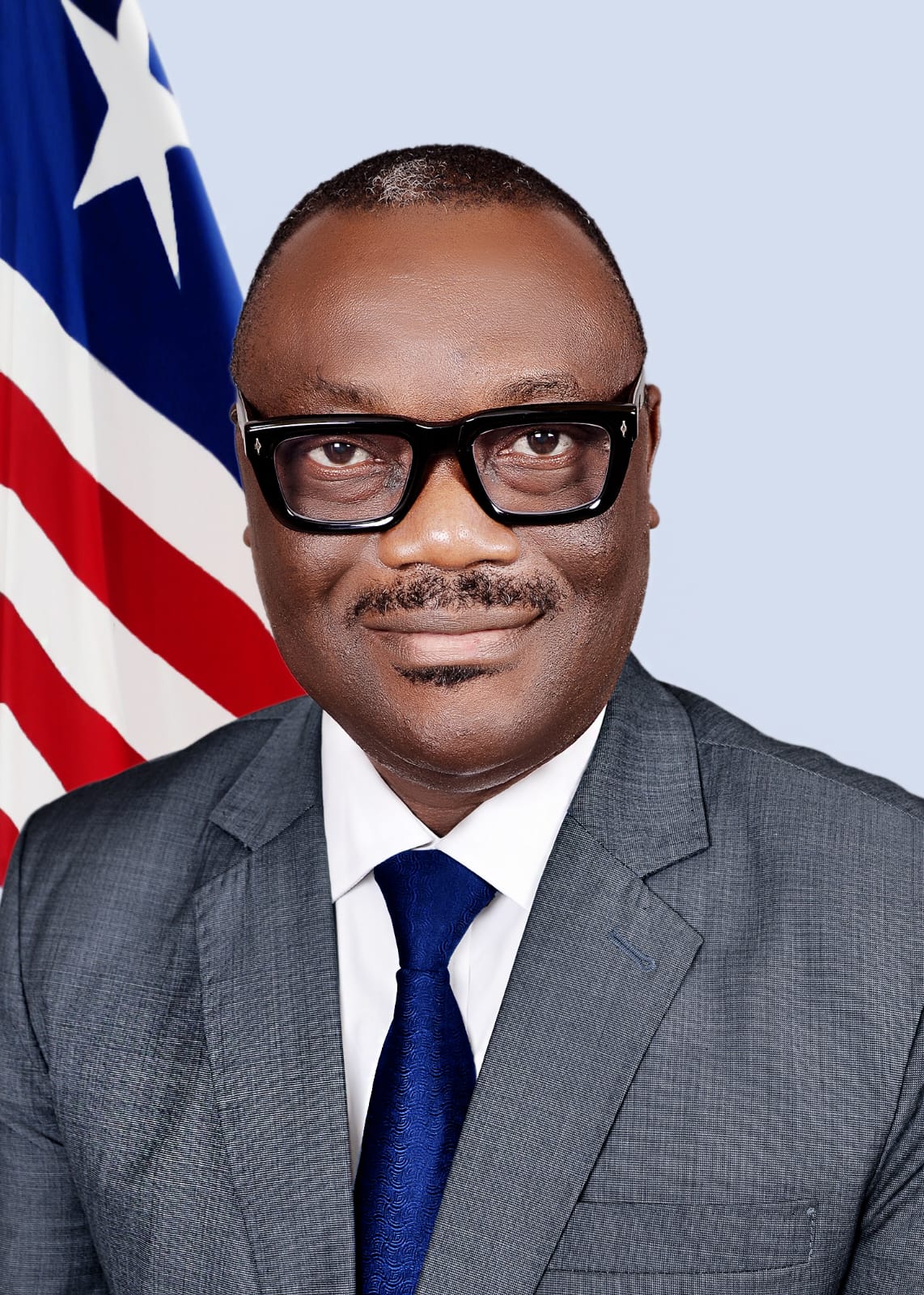
HIS HONOR JUDGE OUSMAN FRITZ FEIKA
Liberian Jurist | Resident Circuit Judge | President, National Association of Trial Judges of Liberia
His Honor Judge Ousman Fritz Feika is a Liberian jurist and judicial leader whose career reflects a
sustained commitment to the administration of justice, judicial independence, professional excellence,
institutional accountability, and the continuing development of Liberia's trial judges.
He serves as Resident Circuit Judge of the Fifth Judicial Circuit Court of Grand Cape Mount County,
Republic of Liberia, and is the President of the National Association of Trial Judges of Liberia
(NATJL), having been elected to lead the national professional association of Liberia's trial judges in
February 2026.
Born on June 30, 1967, his professional journey has taken him from the practice of law and admission
proceedings before Liberia's Supreme Court to the Circuit Court bench and, subsequently, to national
judicial leadership. His career illustrates the evolving role of the modern trial judge—not simply as an
adjudicator of individual disputes, but as a guardian of due process, a steward of public confidence, an
institutional leader, and a participant in the continuing development of the justice system.
I. A JURIST OF THE LIBERIAN TRIAL BENCH
Judge Feika's judicial appointment dates to November 15, 2018, when he was appointed as Resident
Judge of the Fifth Judicial Circuit, Grand Cape Mount County.
Consequently, Judge Feika's service as Resident Judge places him at the centre of the administration
of justice in one of Liberia's judicial circuits and gives him responsibility for adjudicating matters
affecting individuals, families, businesses, communities, and government institutions.
II. FROM THE BAR TO THE BENCH
Judge Feika's path to the judiciary was preceded by professional engagement with Liberia's legal
system. He practiced as a corporate lawyer with one of Liberia’s renown law firms (Sherman &
Sherman Inc.) for many years as an associate before his appointment by the President of Liberia to the
bench as a circuit judge in 2018. He also served as President of the Grand Cape Mount Chapter of
Liberia National Bar Association for many years.
This progression is important in understanding his professional development. It reflects movement
through Liberia's legal profession toward the higher responsibilities associated with judicial office.
III. THE FIFTH JUDICIAL CIRCUIT
As Resident Judge of the Fifth Judicial Circuit, Judge Feika has carried the responsibility of
administering justice in Grand Cape Mount County, and as well as other circuits around the country.
The office of Resident Circuit Judge requires more than the ability to decide contested questions of
law. It demands the management of a court, supervision of proceedings, engagement with lawyers and
litigants, observance of procedural safeguards, protection of the rights of parties, and the preservation
of public confidence in the judicial process.
The modern trial judge must therefore combine legal knowledge with temperament, independence
with accountability, authority with restraint, and efficiency with fairness.
It is within this demanding environment that Judge Feika's judicial career has developed.
IV. SERVICE BEYOND HIS RESIDENT CIRCUIT
Judge Feika has also undertaken judicial assignments beyond Grand Cape Mount County.
His service has included judicial responsibilities in Montserrado County, Liberia's most populous
county and the location of the Temple of Justice in Monrovia, Grand Bassa County, Gbarpolu County,
Bomi County.
Service in the Criminal Assizes for Montserrado County brings a judge into contact with cases of
considerable public interest and complexity. It also places the trial judge under intense public scrutiny
and requires careful balancing of the interests of the State, accused persons, victims, witnesses,
lawyers, and the broader community.
Judge Feika's assignment to Criminal Court "C" therefore represents an important stage in his judicial
career.
V. JUDICIAL INDEPENDENCE AS A PROFESSIONAL VALUE
A defining principle associated with Judge Feika's judicial leadership is the importance of judicial
independence.
For Judge Feika, judicial independence is not simply an institutional privilege belonging to judges. It
is a constitutional safeguard designed to ensure that citizens can come before a court confident that
their cases will be decided according to law rather than political pressure, personal influence, fear,
favor, or public sentiment.
At the same time, judicial independence carries a corresponding obligation.
An independent judge must be:
faithful to the Constitution and laws;
impartial toward every litigant;
respectful of due process;
transparent in the exercise of judicial authority;
accountable for professional conduct; and
courageous enough to apply the law even when the result is unpopular.
This understanding of independence is particularly important in emerging and consolidating
democracies, where confidence in the institutions of justice is indispensable to constitutional
government.
VI. LEADERSHIP OF THE NATIONAL ASSOCIATION OF TRIAL JUDGES OF LIBERIA
Judge Feika's national judicial leadership reached a significant milestone in February 2026, when he
was elected President of the National Association of Trial Judges of Liberia at the Association's
conference in Ganta, Nimba County.
The presidency of NATJL gives Judge Feika a role extending beyond the adjudication of individual
cases.
As head of the professional association representing Liberia's trial judges and magistrates, he has an
institutional platform from which to address matters affecting:
Judicial welfare
Judges and magistrates must have appropriate working conditions and institutional support if they are
expected to administer justice independently and efficiently.
Professional development
Judicial competence requires continuing education. Laws change, jurisprudence evolves, technology
transforms evidence and procedure, and new forms of crime and commercial activity present novel
questions for the courts.
Judicial independence
A professional association of trial judges has a legitimate role in defending the institutional
independence and dignity of trial judges.
Accountability and ethics
Judicial independence cannot be separated from judicial responsibility. Public confidence requires
both.
Access to justice
The ultimate beneficiary of an effective judiciary must be the citizen who comes before the court
seeking justice.
VII. THE MODERNIZATION OF THE TRIAL JUDICIARY
Judge Feika's leadership philosophy places particular importance upon strengthening the institutional
foundation of the trial courts.
A modern judiciary cannot depend exclusively upon the individual commitment of judges. It requires:
a. adequate court infrastructure;
b. reliable access to legal authorities;
c. continuing judicial education;
d. modern information and communications technology;
e. effective case-management systems;
f. competent court personnel;
g. appropriate security;
h. institutional financial support; and
i. mechanisms for professional accountability.
This perspective recognizes a fundamental truth:
Judicial independence requires institutional capacity.
A judge cannot be expected to deliver timely and quality justice where the institution itself lacks the
tools necessary to perform its constitutional responsibilities.
For this reason, Judge Feika's national leadership has placed emphasis on strengthening judges and
magistrates not only intellectually and professionally, but also institutionally.
VIII. INVESTMENT IN JUDICIAL EDUCATION
One of the recurring themes of Judge Feika's professional leadership has been continuing judicial
education.
He has participated in the organization of national judicial conferences and professional programs
intended to bring judges and magistrates together to examine emerging legal questions, share
experience, and strengthen judicial competence.
This approach reflects a philosophy that judicial learning does not end when an attorney is appointed
to the bench.
Rather:
The judge remains a student of the law throughout his or her judicial career.
The principle is especially important in Liberia, where trial courts confront a broad range of legal
questions involving criminal justice, land disputes, commercial transactions, constitutional rights,
administrative decisions, family matters, public corruption, and other complex issues.
Judicial education therefore serves two purposes: it strengthens the individual judge and, through the
judge, strengthens the justice system itself.
IX. ACCOUNTABILITY AND PUBLIC CONFIDENCE
Judge Feika's professional record also includes participation in Liberia's public accountability
framework.
The Liberia Anti-Corruption Commission's official records identify his asset declaration of August 5,
2024, and record the declaration as compliant.
For judicial leaders, accountability is inseparable from independence. A judiciary that demands
independence must also demonstrate integrity. The public is entitled to expect judges to conduct
themselves in a manner consistent with the dignity of judicial office, and judges in turn must be able
to insist upon independence because they have demonstrated fidelity to the law and to ethical
standards.
X. THE TRIAL JUDGE AND DEMOCRATIC GOVERNANCE
Judge Feika's professional leadership is situated within a larger constitutional principle: democracy
cannot be sustained without an independent judiciary.
Elections establish governments. The Legislature enact laws. The Executive administer public policy.
But courts provide the institutional mechanism through which constitutional rights are vindicated,
governmental authority is reviewed, disputes are resolved, and the rule of law is given practical effect.
XIII. A LEADER AT A CRITICAL MOMENT FOR LIBERIA'S JUDICIARY
Judge Feika's assumption of the NATJL presidency comes at an important period in Liberia's judicial
development.
The country continues to face familiar structural challenges: court congestion, inadequate
infrastructure, limited resources, the need for greater access to legal research, demands for continuing
professional education, and the continuing public expectation that justice should be delivered
promptly and fairly.
These challenges require leadership that is both principled and practical.
The future of Liberia's trial judges association will depend not merely upon judges possessing legal
knowledge, but upon whether the institution can build a culture of:
competence, integrity, independence, efficiency, accountability, technology, professional solidarity,
and public service.
Judge Feika's leadership platform is positioned within that broader institutional challenge.
XIV. HIS VISION FOR THE TRIAL JUDGES ASSOCIATION
At the center of Judge Feika's judicial philosophy is a simple but profound proposition:
A strong judiciary is essential to a strong democracy.
That proposition carries several implications.
A judge must be independent because justice cannot be administered under intimidation.
A judge must be competent because independence without competence can produce injustice.
A judge must be accountable because power without responsibility can undermine public confidence.
A judge must be compassionate because the law ultimately affects human beings.
And a judge must be courageous because justice sometimes requires decisions that are neither
politically convenient nor publicly popular.
These principles provide a framework for understanding Judge Feika's approach to judicial leadership.
XV. AN INTERNATIONAL JUDICIAL PERSPECTIVE
Judge Feika's professional experience also has relevance beyond Liberia.
Across Africa and other emerging democracies, judiciaries confront common questions:
How can judicial independence be protected?
How can courts become more efficient without sacrificing due process?
How can judges maintain public confidence?
How can judicial education keep pace with changing law and technology?
How can courts provide meaningful access to justice despite limited resources?
These are not exclusively Liberian questions.
They are questions confronting judicial systems around the world.
The experience of Liberia's trial judiciary therefore provides an important contribution to the
international conversation about judicial resilience, democratic governance, access to justice, and the
rule of law.
As President of NATJL, Judge Feika is positioned to contribute to that conversation from the
perspective of a practicing African trial judge who combines courtroom adjudication with institutional
leadership.
XVI. PROFESSIONAL LEGACY IN THE MAKING
Judge Ousman Fritz Feika's judicial career remains ongoing.
His professional legacy will ultimately be measured not simply by the number of cases he has decided
or positions he has occupied, but by the institutional and human impact of his service.
A judge's true legacy is found in whether litigants were treated with dignity; whether the law was
applied fairly; whether constitutional rights were protected; whether justice was delivered without fear
or favor; whether the courtroom remained a place where truth could be heard; and whether the
institution became stronger because of the judge's service.
As Resident Judge of the Fifth Judicial Circuit and President of NATJL, Judge Feika now occupies
two positions that provide an unusual opportunity for such service.
One gives him direct judicial authority.
The other gives him a national professional platform.
Together, they create an opportunity to contribute to the strengthening of Liberia's trial judges at both
the individual adjudicative level and the institutional level.
XVII. CONCLUSION
His Honor Judge Ousman Fritz Feika is a Liberian jurist whose career has evolved from legal practice
and professional admission before the Supreme Court into service on the Circuit Court bench and,
ultimately, national leadership of Liberia's trial judges.
Appointed to the Fifth Judicial Circuit in 2018, he has served as Resident Circuit Judge of Grand
Cape Mount County and undertaken judicial assignments in other counties of Liberia.
His election in February 2026 as President of the National Association of Trial Judges of Liberia
represents the latest chapter in that professional journey.
← Back to Leadership